Shrimp Sorting - MVTec Halcon

MVTec HALCON makes shrimp sorting fast and efficient. The shrimp sorting system from De Boer RVS uses our machine vision software HALCON to distinguish relevant catch (shrimps) from not-relevant by-catch in real-time. 

As a consequence of this highly efficient sorting, this application does not only improve the fishing outcome, but also helps to protect the environment, as the alive by-catch is conveyed back to the sea immediately.


Find more information about Halcon here: https://mvtec.com

Find more information about Machine Vision here: http://advanceultravision.com/

Sweet Pepper Robot detects and picks ripe crops - MVTec Halcon

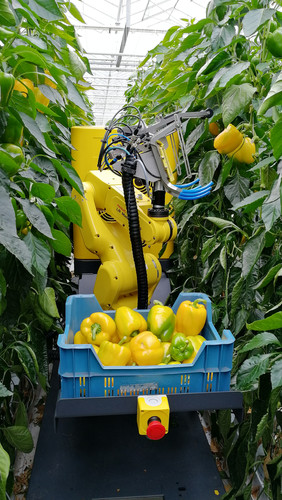
The Wageningen University & Research (WUR) in the Netherlands developed a greenhouse harvesting robot, which is able to pick ripe crops. The shape- and color-based detection algorithm for this task was implemented using MVTec HALCON.

The organization
The WUR Agro Food Robotics initiative is a joint program by several research groups of the Wageningen University & Research. The program tries to bring new knowledge to practice by carrying out feasibility studies, functional designs, prototype development, testing, validation and by supporting new product implementations.

The challenges
In the past decades the food production in greenhouses has been confronted with the increasing size of production facilities, increasing labor demands and increasing product quality demands by the consumers. Many operations are still done manually, for example the harvesting. 

However, the availability of a skilled workforce that accepts repetitive tasks in the harsh greenhouse climate conditions is decreasing rapidly. Robotics and sensing technologies are an alternative solution, which makes crop production more efficient and more sustainable.


The solution
Within the scope of the the European research project "Clever Robots for Crops" (CROPS), later the "Sweet Pepper Robot"-project (SWEEPER), the WUR developed a robot to pick sweet peppers. The prototype comprises the following modules: a tool to cut and catch the pepper; a combined color and 3D camera; an industrial six degrees of freedom robot arm, computers and electronics, all assembled on a battery powered platform that moves the robot autonomously through the greenhouse. 

Once the camera system has found a ripe pepper, the robotic arm positions the tool on top of the crop stem. The arm then moves the tool a few centimeters down with a vibrating knife and cuts off the pepper crop near the main plant stem.


Object detection with MVTec HALCON
A central function in the SWEEPER robot is detection of ripe crops. For successful operation, the 3D location of each crop must be determined with high accuracy. The chosen solution is based on an RGB-D camera that simultaneously reports color and depth information. 

Using this camera and a custom built LED-based flash-light illumination system, RGB images of the plant are acquired from both overview distance and close range. In order to facilitate high frame-rate operation, a straight forward shape- and color-based detection algorithm was implemented using HALCON. The algorithm scans each acquired image for regions matching the target color thresholds. 

Detected regions are refined by removing detections exceeding predefined minimum/maximum sizes. To further remove misdetections additional shape parameters are calculated. Finally, depth information from the camera is used to compute the volume of the detected regions. This information is then used to further prune false detections, avoid non-harvestable crop clusters, and define harvest priorities. 

The exact 3D location of the point of mass is calculated using the depth information extracted from the detected region and a standard procedure of pixel-to-world transformation of the region. Given the subsets of regions that are classified as peppers to be harvested, a methodology for harvesting sequencing was defined. The robot arm then approaches the target by visual-servo control that keeps the target in the middle of the images until it is reached.

You can download the full success story here.

Find more information about Halcon here: https://mvtec.com
Find more information about Machine Vision here: http://advanceultravision.com/

Windshield Loading in Automative Assembly Lines - LMI Gocator

TopEagle displays Bluewrist EzRG robot guidance solution with the LMI Technologies Gocator Sensors for windshield loading in assembly lines.

Gocator laser line profile sensors are used to locate and measure the gap between the frame and windshield.


For more applications in the automotive industry check out:
https://lmi3d.com/solutions/industries/automotive

Find more information about LMI Gocator here: https://lmi3d.com/products/gocator-3D-smart-sensors

Find more information about Machine Vision here: http://advanceultravision.com/

Surface Circular Edge Tool - LMI Gocator

The Surface Circular Edge tool provides easy and powerful measurement of circular surface features, including sophisticated roundness measurement.

The tool can be quickly adapted to measure inside or outside features, as well as rising or falling edges.


Find more information about LMI Gocator here: https://lmi3d.com/products/gocator-3D-smart-sensors

Find more information about Machine Vision here: http://advanceultravision.com/

Mercury USB3 Camera - Daheng Imaging


Daheng Imaging’s industrial cameras are on average 30% to 50% cheaper than comparable products, due to our smart business model, which for example includes low margin per product. 

We also focus on low overhead costs, no unnecessary features, scale advantage, and labor costs. This results in less development time, less expensive hardware, lower cost price, and lower development costs per product. 

Of course; it helps that labor costs are lower in China and that Daheng Imaging is one the largest machine vision camera manufacturer in China.

Reliable and High-Quality Industrial Camera

Daheng Imaging tests every industrial camera before leaving the factory, whereby quality is guaranteed. The vision cameras have to withstand a 7-day aging test in warm and cold temperatures and a 72-hour full load test. 

The industrial cameras are CE certified by TUV Rheinland, making sure we meet and exceed the European quality standards.


Note: "Daheng Imavision" is the old name for DAHENG IMAGING.


The Mercury USB3 series (MER-U3) camera are for industrial, pharmaceutical and machine vision applications. Our cameras comply with the industrial “USB3 Vision” standard. The industrial USB camera is equipped with a CMOS or CCD image sensor.

The dimensions of the camera are 29x29x29mm. You can choose between an industrial USB camera with or without digital in and output (I/O). The USB camera without I/O is indicated with an article number that ends with (“-L”).


If you need to loan the camera for performance testing and benchmarking purposes, please contact us. Contact information here: https://advanceultravision.blogspot.com/p/contact.html

Find more information about Daheng Imaging here: http://www.daheng-imaging.com/en/

Find more information about Machine Vision here: http://advanceultravision.com/

Halcon Deep Learning Sample Application - Teknix(South Korea), MVTec Halcon


Find more information about Halcon Deep Learning here: https://www.mvtec.com/services-solutions/technologies/deep-learning/

Find more information about Machine Vision here: http://advanceultravision.com/

Latest Camera Interface Revisions & Maintenance Releases - MVTec Halcon

The following HALCON interfaces have recently been updated:

USB3Vision 13.0.8
GigEVision2 13.0.4 
GenICamTL 13.0.6
Hilscher-cifX 13.0.3
OPC_UA 13.0.7
AlkUSB3 13.0.1


You can download the latest interface here: https://www.mvtec.com/products/interfaces/

Find more information about Machine Vision here: http://advanceultravision.com/